
Every time the market closes at a new record, a headline turns up warning that the good times are about to end. The logic sounds intuitive: what goes up must come down. But the data don't back it up. A new high isn't a warning sign. It's the market doing exactly what it's supposed to do.
Stocks aren't defying gravity when they climb to new highs. Stocks are claims on the future earnings of real companies, and their prices reflect what investors collectively believe those earnings are worth today. Stocks are priced to deliver a positive return in line with those earnings expectations, so hitting new highs with some regularity isn't an anomaly. It's the expected outcome.
Looking at every monthly closing level for the S&P 500 Index between 1926 and 2025, close to a third of those months—31%—represented new highs. That's not rare; it's what happens to stock prices as the economy grows over time.
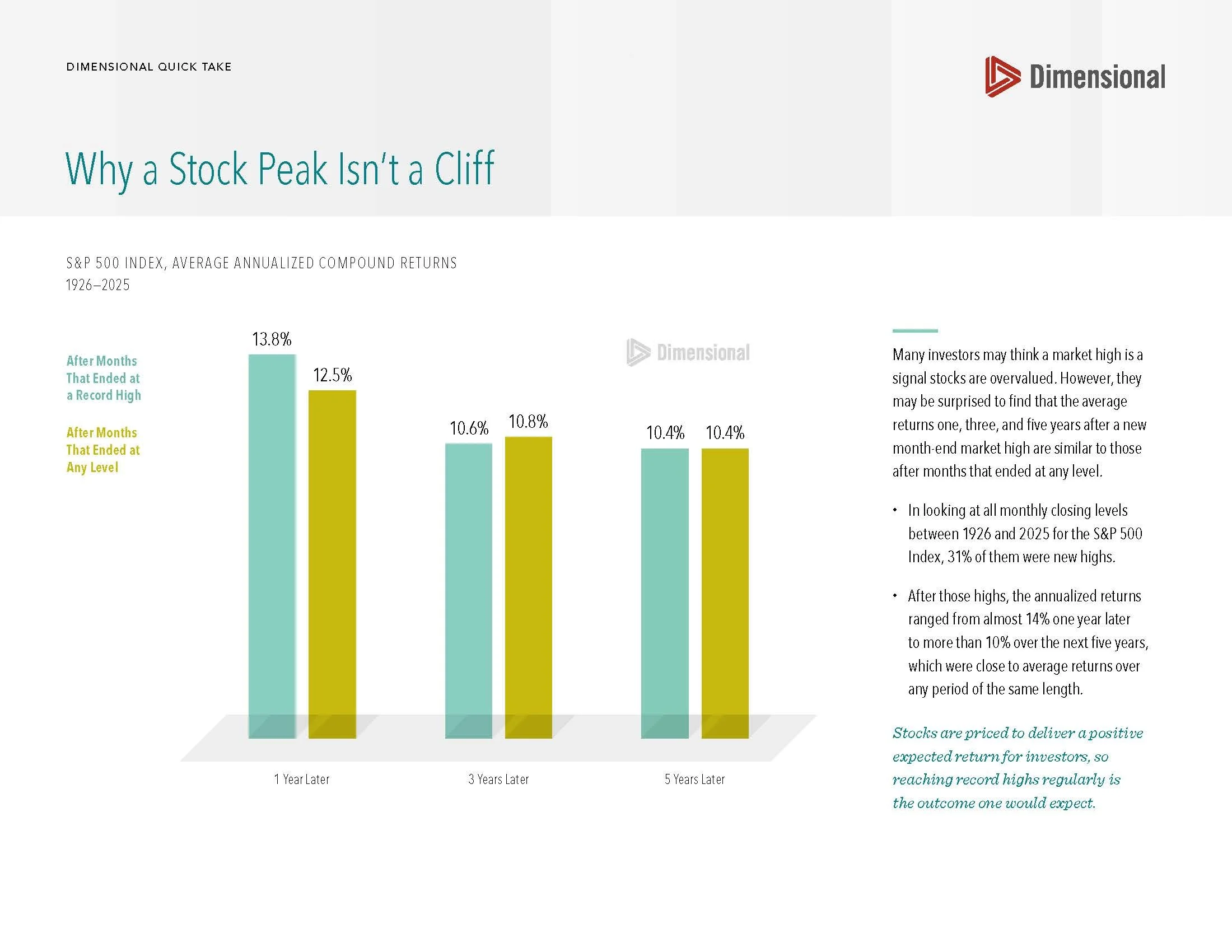

If new highs were a red flag, the market would punish investors who bought in at those moments. It doesn't. In the year following a new monthly high, the market went on to return an average of 13.8% annualized—actually a touch higher than the 12.5% average following any other month. Stretch the window to three or five years, and the numbers converge to within a fraction of a point of each other.
New highs aren't rare exceptions to be feared—they're just part of how a rising market behaves.
So what should you do with this information? Mostly, nothing. Don't let a headline about "all-time highs" talk you into selling out of fear, and don't let it talk you into chasing momentum either. The instinct to time your moves around a number the market just crossed is understandable. Still, it isn't supported by how markets have actually behaved.
What's worth your attention is the things you can control: how much you're saving, whether your asset allocation still matches your goals and timeline, and whether you're staying invested through the noise. In my view, those levers move the needle far more than trying to guess when a record high is "too high." A new peak isn't a signal to act. It's just Tuesday.
___________________________
Source: Dimensional Fund Advisors, 2025 Quick Take. Past performance is not a guarantee of future results. The S&P 500 Index is not available for direct investment.